Basic Criteria in Aluminum Injection Mold Design
16 July 2026

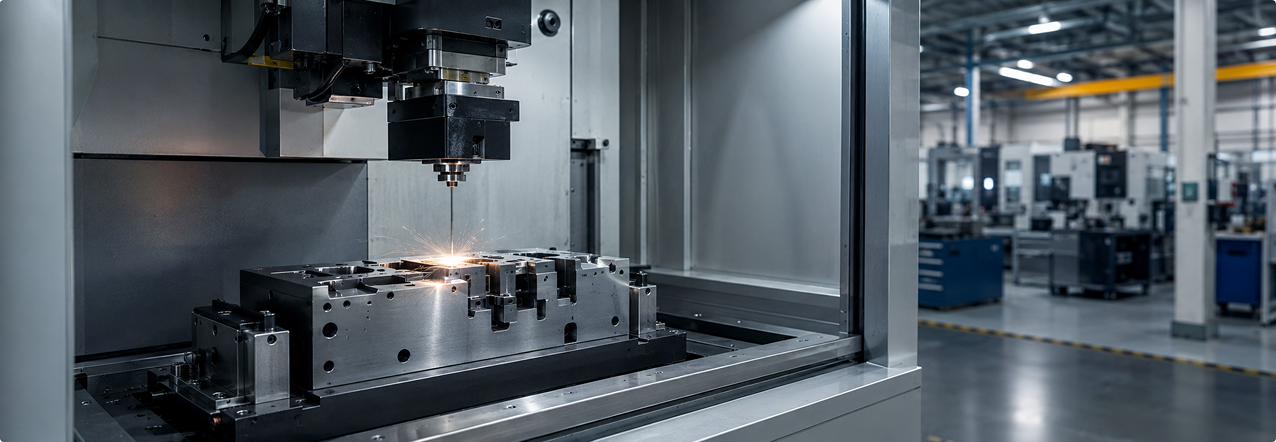
Also known as electrical discharge machining, erosion relies on the removal of material through controlled sparks in conductive materials. Material is removed without direct contact between the workpiece and the electrode. This feature allows for precise machining of high-hardness tool steels and complex mold components. Erosion technologies are especially widely used in mold, tool, and precision part manufacturing.
In die sinking erosion, the electrode is prepared with a surface shape opposite to the desired geometry and transferred onto the workpiece. The electrode is usually made from highly conductive materials such as copper or graphite. Deep cavities, sharp internal corners, fine channels, and details that the cutting tool cannot directly reach can be created with this method.
Complex cavities, ribs, and narrow surfaces found in aluminum injection, zinc, and trimming molds are among the primary applications of die sinking erosion. The method supports achieving high precision and controlled surface quality on mold surfaces.
Wire erosion cuts the workpiece along a specified contour using a thin wire electrode. The absence of strong mechanical force during cutting helps reduce the risk of deformation in precise and small mold components.
Cutting plates, mold inserts, punches, and parts requiring precise fitting can be prepared with wire erosion. The ability to process straight, inclined, or complex contours repeatedly makes this method an important stage in mold production.
The success of wire erosion is closely related to the accuracy of the electrode geometry. Electrodes are designed using CAD and CAM data, then precisely machined on CNC machines. Wear allowance, spark gap, and surface expectations should be considered in electrode design.
Different electrodes can be used for rough and finish operations on the same mold area. This approach helps control processing time and achieve the desired surface quality more systematically.
After erosion, mold clearance, depth, angle, and surface values should be checked. Electrode wear or incorrect process settings can cause dimensional deviations. Therefore, process parameters, electrode condition, and dielectric fluid cleanliness are monitored throughout production.
The combined use of CNC machining and erosion methods contributes to completing difficult geometries in mold production and achieving the desired fit between components.